Why clean email lists land in more inboxes and get better marketing results
Email still works. But even a great campaign falls flat if the messages never reach the inbox, and that’s exactly what happens when deliverability slips. A list full of dead addresses, spam traps, inactive users, or plain typing mistakes quietly damages your sender reputation until your mail starts landing in spam. Validating the list removes those risks so your campaigns reach people who will actually see them.
What email deliverability actually means
Deliverability is your ability to land mail in the recipient’s primary inbox rather than the spam folder, or worse, bouncing outright. It isn’t the same thing as delivery rate.
- Delivery means the email reached the server.
- Deliverability means it reached the inbox and got seen.
You can hit a 99% delivery rate and still have poor deliverability. The usual culprits:
- Poor domain or IP reputation
- Invalid or risky addresses on your list
- Spam filters tripped by content or sending patterns
- Content quality slipping over time
- Recipients marking your emails as spam
A simple way to picture it: delivery is getting the letter into the mailbox. Deliverability is getting it opened and read. Gmail, Outlook, and Yahoo all score senders on trust, and low scores compound. Poor deliverability doesn’t just cost you opens today; it wears down how much mail providers will accept from you going forward.
How list quality shapes deliverability
List quality is the loudest signal email service providers (ESPs) use to judge whether you’re trustworthy. Fill it with invalid, unengaged, or risky contacts, and platforms treat everything you send as suspect, even when the content itself is good.
Bad list hygiene shows up as four problems:
- High bounce rates: Hard bounces come from addresses that don’t exist; soft bounces from full inboxes or temporary issues. Anything above 2% draws attention.
- Spam traps: Honeypot addresses set up to catch anyone mailing bought or outdated lists. One hit can hurt your reputation for months.
- Low engagement: When nobody opens, clicks, or replies, ESPs conclude your mail is unwanted and route future sends toward spam.
- Complaints: Every repeated “mark as spam” click drags your scores down fast.
All of this traces back to one cause: low-quality addresses finding their way onto your list. Catch them at the source and the problem never gets a chance to grow.
What email list validation actually does
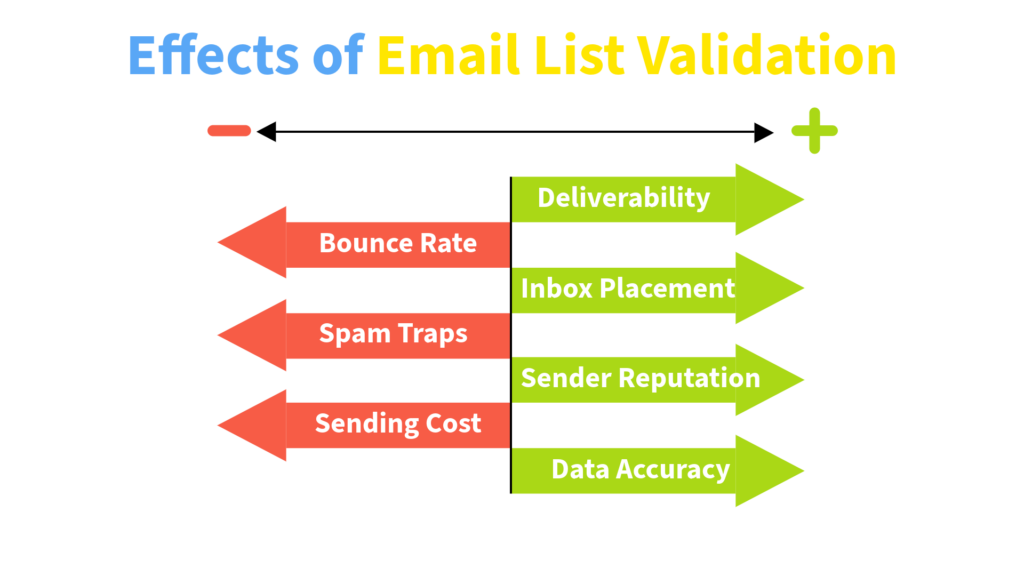
Validation scans your list and flags risky, invalid, or harmful addresses before you hit send. Good tools check several layers for accuracy.
The main checks:
- Syntax errors: Catches typos like [email protected] instead of [email protected].
- Domain verification: Confirms the domain exists and accepts mail (so you skip defunct company domains).
- Mailbox existence: Verifies the specific address is live and can receive mail.
- Disposable emails: Flags one-time-use inboxes like temp-mail.org addresses.
- Role-based emails: Spots shared, low-engagement addresses like info@, admin@, or support@.
- Spam traps: Detects monitoring addresses run by ESPs.
- Catch-all domains: Identifies servers that accept anything at first, then bounce later.
- Risk scoring: Rates addresses for potential harm, such as known abuse patterns.
Filter these out early and every send goes to real, engaged inboxes. You spend less on the sends themselves and protect your reputation while you’re at it.
Why email validation significantly improves deliverability
Clean lists produce results you can measure. The gains show up in a few places.
A. Lower Bounce Rates
Pull invalid emails out and bounces fall below 2%, one of the strongest signals ESPs watch. Gmail and Outlook read that as reliability and reward it with better placement.
B. Stronger Sender Reputation
ESPs track bounces, trap hits, and inactive recipients. Validation keeps those off your record, so your domain/IP score builds steadily instead of sliding backward.
C. More Inbox Placement
Better scores put more mail in primary inboxes. That typically lifts opens by 20-30%, and clicks, conversions, and ROI follow.
D. Higher Engagement Rates
Cutting fakes and throwaway addresses often raises open rates by 10-15%, with CTR and replies climbing too. An engaged list tells ESPs your mail is wanted, which earns you even more inbox space next time.
E. Fewer Spam Complaints
Once non-engagers and risky addresses are gone, clean lists hold complaint rates under 0.1%. Nothing protects a reputation like that.
F. Smarter Segmentation
With reliable data you can segment by active users, new subscribers, or high-intent leads. Relevant emails earn higher relevance scores, and relevance feeds straight back into deliverability.
G. Accurate Analytics
Dead contacts skew your numbers (fake “opens” from ghosts included). Clean lists show what performance actually looks like, which makes planning far less guesswork.
Real-world example: a SaaS company validated a 50K list, cut bounces by 65%, and saw opens jump 28% in one campaign.
Deliverability metrics to monitor post-validation
Track these to quantify the wins:
- Bounce Rate: Aim <2%.
- Open Rate: Expect 5-15% gains.
- Click-Through Rate (CTR): Rises as more mail reaches the inbox.
- Spam Complaint Rate: Keep <0.1%.
- Inbox Placement Rate: Tools like GlockApps test this directly.
- Sender Reputation Score: Check via SenderScore or Google Postmaster Tools.
- Unsubscribe Rate: Lower means better fit.
Watch the trend monthly rather than any single campaign; consistent gains are what prove validation’s ROI.
Signs you need to validate your list now
Don’t wait for disaster. Take these as your cue:
- Bounce rates creeping over 2%
- Open rates dropping suddenly
- Emails hitting spam consistently
- Rising complaints
- 20% inactive contacts
- Recent list purchases or imports
- Offline event signups (error-prone)
- Subscribers dormant for 6+ months
Any of these points to reputation damage already underway. Validate right away to limit it and start recovering.
How often to validate your list
A sensible rhythm:
- Every new batch: Validate imports instantly.
- Full list: Every 2-3 months (or 6 if highly active).
- Pre-campaign: Before big blasts.
- Post-import: After CRM syncs or lead gen tools.
Automate it and the schedule takes care of itself.
Email list validation isn’t a nice-to-have anymore; it’s basic hygiene for modern marketing. It protects your sender reputation, keeps mail in the inbox, improves engagement, and in the end protects revenue.
Start small. Validate one list today and watch the numbers. Once you see what clean data does for a campaign, you won’t want to send without it.